By PersonalTrainerXP | Mr India Medal Holder | ACE Certified Personal Trainer | 9+ Years Experience | Professional Fitness Coaching Under $20/Hour
Why Indian Men Struggle to Lose Belly Fat Abroad — The Real Reason Nobody Talks About — PersonalTrainerXP You hit the gym three times a week. You switched from butter chicken to grilled chicken. You downloaded a calorie-counting app. You even tried that intermittent fasting protocol your colleague recommended. And yet — the belly is still there. Maybe it’s getting worse.
If you’re an Indian man living in the USA, UK, Canada, Australia, UAE, or anywhere else in the Western world, you are not alone. This is one of the most searched, most frustrated, and most misunderstood health problems facing the global South Asian diaspora today. Why Indian Men Struggle to Lose Belly Fat Abroad — The Real Reason Nobody Talks About — PersonalTrainerXP Built by an ACE-certified trainer with 9+ years of experience, this science-backed protein calculator applies the Morton et al. 2018 and Stokes et al. 2018 evidence-based ranges. personaltrainerxp
The truth? The standard “eat less, move more” advice was not designed for your body, your food culture, your stress patterns, or your metabolic genetics. And until you understand why Indian men specifically struggle with belly fat abroad, no generic fitness plan will ever work long-term.
This is the most in-depth, most honest, most science-backed guide on belly fat for Indian men living abroad that you will find anywhere online. Read every word. Your health — and honestly, your life — depends on it. South Asian metabolic patterns often mean your calorie needs differ from Western population averages. Use the TDEE calculator for Indian body types to get a personalized energy estimate that accounts for your actual stats.
The Hidden Epidemic: Why Indian Men Gain Belly Fat When They Move Abroad Why Indian Men Struggle to Lose Belly Fat Abroad — The Real Reason Nobody Talks About — PersonalTrainerXP
Why Indian Men Struggle to Lose Belly Fat Abroad — The Real Reason Nobody Talks About — PersonalTrainerXP Let’s start with the numbers, because they are alarming.
South Asian men have statistically higher rates of visceral fat accumulation, insulin resistance, and cardiovascular disease than almost any other ethnic group — even at lower body weight. A South Asian man with a BMI that would be classified as “normal” in Western standards can carry dangerous levels of abdominal fat. This is not a myth. This is published science. The roti and dal calorie calculator tells you the exact macros in your everyday staple meals.
Studies on the South Asian metabolic syndrome have consistently shown that Indians, Pakistanis, Bangladeshis, and Sri Lankans store significantly more fat around the abdominal organs — called visceral fat — at lower body mass than their White, Black, or East Asian counterparts. The World Health Organisation itself recommends lower BMI cutoffs for South Asians precisely because of this risk. The Harris-Benedict and Mifflin-St Jeor equations power our accurate BMR estimation tool for men and women.
Now add the trauma of migration: a completely new food environment, no family structure around meals, sedentary desk jobs, social isolation, disrupted sleep from different time zones, cold weather, alcohol at office parties, and the psychological weight of proving yourself in a new country. The result is a perfect metabolic storm.
This is why Indian men in USA, UK, Canada, and Australia gain belly fat rapidly after arriving, often within 12 to 18 months of relocation. This is why NRI men can’t lose belly fat even when they try hard. And this is why standard Western fitness advice consistently fails the desi male body. fitness goals program — Set, track, and crush your fitness goals program with the help of a certified coach who holds you accountable.
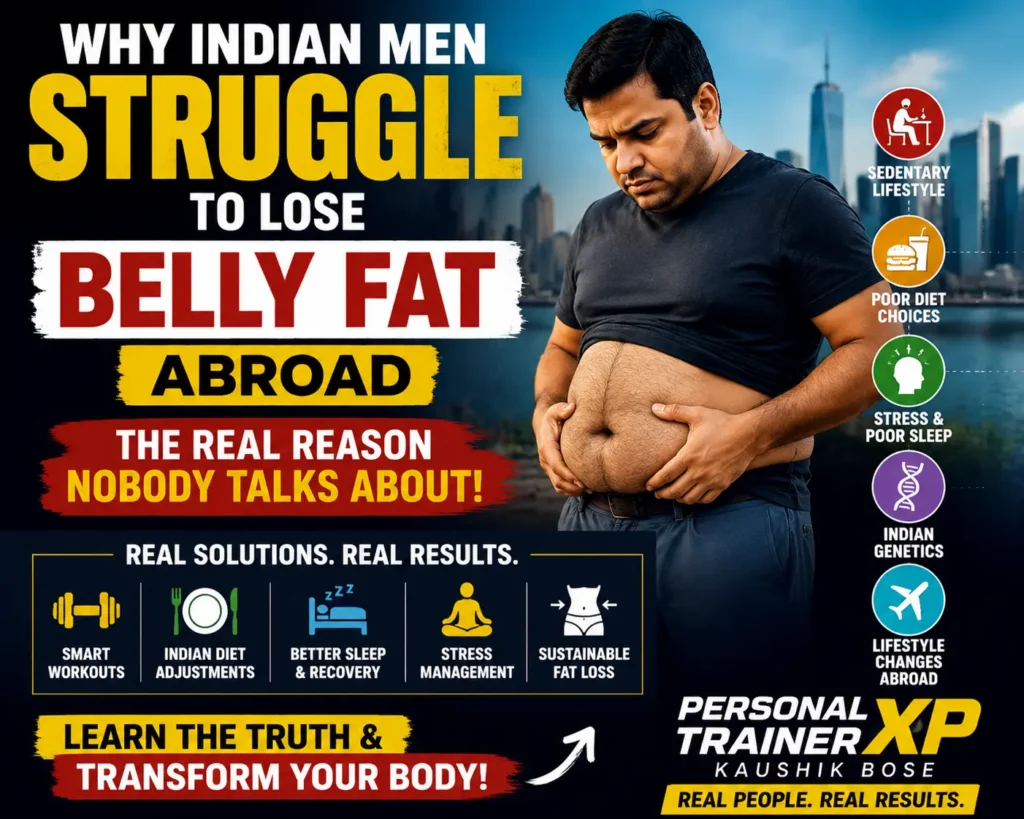
Reason #1 — The South Asian Genetics Problem (Why Our Bodies Store Fat Differently) Why Indian Men Struggle to Lose Belly Fat Abroad — The Real Reason Nobody Talks About — PersonalTrainerXP
Before we talk about diet and exercise, we need to talk about biology. Because if you don’t understand this, you will keep blaming yourself for something that isn’t entirely your fault.
South Asian genetics predispose Indian men to a higher percentage of body fat at the same muscle mass as men from other ethnicities. This is sometimes called the “South Asian body paradox” — you can look lean and still carry dangerous visceral fat around your liver, pancreas, and intestines.
Why does this happen? Researchers believe it is a combination of evolutionary adaptation and epigenetics. For thousands of years, the Indian subcontinent experienced cycles of feast and famine. The bodies that survived were the ones that stored energy most efficiently — particularly as abdominal fat, which is the fastest to access in times of crisis. That survival trait, which kept your ancestors alive, is now a liability in a world of unlimited food availability.
Additionally, South Asian men have genetically lower rates of fat oxidation — meaning their bodies are less efficient at burning fat for fuel compared to men of European descent. Indian men also tend to have lower lean muscle mass relative to body weight, which further reduces resting metabolic rate. For Indian nurses, doctors, and healthcare workers abroad managing shift work, night duties, and extreme occupational stress, a fitness coach for Indian healthcare workers abroad designs shift-adaptive workout schedules and nutrition plans that account for circadian disruption, fatigue, and the unique physical demands of medical professions.
What this means practically: an Indian man and a White man can eat the exact same diet and do the exact same workout, and the Indian man will lose belly fat more slowly. This is not failure. This is biology. And it means you need a plan specifically designed for the Indian body type, not a generic Western programme.
Why Indian Men Struggle to Lose Belly Fat Abroad: The Real Reason Nobody Talks About
If you are an Indian man living abroad — in the USA, UK, Canada, Australia, Germany, UAE, or anywhere outside India — and you have noticed that your belly fat simply refuses to go away no matter how hard you try, you are not imagining it. You are not lacking willpower. You are not “just unlucky.” There is a real, scientifically documented, biologically wired reason why Indian men struggle to lose belly fat abroad, and almost nobody explains it properly.
This is not another generic “eat less, move more” article. This is a deep, honest, research-backed breakdown written by a National Medal Holder, ACE and NASM Certified Personal Trainer with over 12 years of coaching experience helping Indian men — especially those who moved abroad for work, study, or a better life — finally understand why their belly fat behaves differently, and exactly how to fix it.
By the end of this guide, you will understand the genetic, hormonal, dietary, cultural, and lifestyle factors working against you, and you will walk away with a clear, practical, doable plan.
The Silent Struggle: A Story Every Indian Man Abroad Knows
You land in a new country with big dreams. New job, new city, new life. Slowly, without noticing, your waistline starts expanding. You tell yourself it’s temporary — “settling in stress,” “new food,” “busy schedule.” Two years pass. Your jeans size has jumped. Your shirts pull tighter around the stomach. You join a gym. You try running. You cut down rice. Nothing moves the needle the way it should.
Meanwhile, you notice your colleagues from other backgrounds seem to lose weight faster on the same diet and the same gym routine. This is frustrating, confusing, and honestly, a little demoralizing. But here’s the truth: it is not your fault, and it is not permanent. It is biology plus environment, and both can be worked with once you understand them.
The Real Reason Nobody Talks About: South Asian Body Composition Is Different
This is the single most important fact that almost no fitness influencer, no random YouTube video, and no generic diet app tells Indian men.
Multiple population health studies on South Asian populations — including Indian men — have consistently shown a pattern researchers call the “Thin-Outside-Fat-Inside” (TOFI) phenotype. This means Indian men can look normal or even slim on the outside, on a standard weight scale or BMI chart, while carrying significantly higher levels of visceral fat — the dangerous fat that wraps around internal organs and concentrates in the abdominal region.
South Asian body composition tends to show:
- Higher percentage body fat at the same BMI compared to Western populations
- Greater tendency to store fat viscerally (around the belly and organs) rather than subcutaneously (under the skin, on hips, thighs, arms)
- Lower muscle mass relative to body weight, meaning a slower resting metabolic rate
- Increased genetic predisposition toward insulin resistance, even in people who are not clinically overweight
This is why an Indian man weighing 75 kg with a “normal” BMI can carry more visceral belly fat than a Western man of the same height and weight who looks visibly heavier. The scale lies. The mirror lies. The waistline tells the truth.
This single biological difference is the real reason why generic Western fitness advice, generic calorie calculators, and generic “just do keto” or “just do intermittent fasting” content simply does not work the same way for Indian men. Your body starts the game with a different rulebook.
Why This Gets Worse the Moment You Move Abroad
Genetics load the gun. Lifestyle abroad pulls the trigger. Here is exactly how moving out of India accelerates belly fat gain in Indian men.
1. Complete Disruption of Traditional Eating Patterns
In India, even a busy professional typically eats home-cooked meals with dal, sabzi, roti, rice, and fresh vegetables prepared with minimal processed ingredients. Abroad, this changes fast:
- Meal prepping becomes a chore instead of a habit
- Restaurant food, ready meals, and packaged food become default choices
- Portion sizes in Western countries are often 1.5x to 2x larger than typical Indian home servings
- Hidden sugars in bread, sauces, cereals, and “healthy” packaged snacks add up silently
- Fewer fresh spices and metabolism-supporting ingredients like turmeric, cumin, fenugreek, and ginger are used regularly
2. Sedentary Desk-and-Car Culture
Many Indian cities, despite their chaos, still involve significant incidental walking — to the market, to public transport, around the neighborhood. Abroad, especially in car-dependent countries and desk-based corporate jobs, daily incidental movement drops dramatically. Less walking, more sitting, more driving — this alone can add several kilos of belly fat per year without any change in diet.
3. Alcohol and Social Drinking Culture
In many Western and Gulf expat social circles, weekend drinking, happy hours, and work social events become a regular part of life. Alcohol is calorie-dense, disrupts fat metabolism by making the liver prioritize processing alcohol over burning fat, increases appetite, and is strongly linked to abdominal fat storage — sometimes literally nicknamed for this reason. Even moderate, “responsible” drinking several times a week can quietly stall fat loss for months.
4. Chronic Stress and Elevated Cortisol
Relocating to a new country brings a unique cocktail of stress: work pressure, visa uncertainty, homesickness, cultural adjustment, financial pressure, and social isolation. Chronic stress elevates cortisol, a hormone directly linked to increased abdominal fat storage. Cortisol also increases cravings for high-sugar, high-fat “comfort foods” — which many Indian men abroad turn to as an emotional anchor to familiar tastes.
5. Disrupted Sleep and Circadian Rhythm
Time zone adjustment, jet lag from frequent trips home, night shifts, and late-night scrolling or video calls with family in India all disrupt sleep quality. Poor sleep is directly linked to increased hunger hormones (ghrelin), decreased satiety hormones (leptin), and higher cortisol — a perfect storm for belly fat accumulation.
6. Vitamin D Deficiency in Colder Climates
Indian men moving to countries with less year-round sunlight often develop vitamin D deficiency, which multiple studies associate with reduced testosterone levels and impaired fat metabolism, particularly around the midsection.
7. Loss of Community-Based Accountability
In India, family, neighbors, and social circles often naturally monitor and comment on weight and health. Abroad, that informal accountability disappears. Nobody notices, nobody comments, and it becomes easy to let things slide for months or years.
8. Testosterone Decline Compounded by Stress and Poor Sleep
Testosterone naturally supports muscle mass and fat metabolism. Chronic stress, poor sleep, alcohol, and sedentary lifestyle abroad all independently lower testosterone — and lower testosterone is strongly correlated with increased abdominal fat storage in men.
9. Gym Culture Mismatch
Many Indian men join gyms abroad but follow generic programs designed without accounting for South Asian body composition, joint mobility differences, or starting fitness levels. Without personalized coaching, progress stalls, motivation drops, and gym visits become inconsistent.
10. Emotional and Nostalgic Eating
Comfort food tied to memories of home — sweets, fried snacks, festival food — becomes an emotional coping mechanism for homesickness, especially around festivals like Diwali, when celebrating abroad without family often leads to overeating as a form of emotional connection.
Genetics vs Lifestyle: Which One Is Really to Blame?
This is one of the most common questions Indian men ask, so let’s break it down clearly.
| Factor | Genetics (South Asian Body Type) | Lifestyle (Living Abroad) |
|---|---|---|
| Fat storage location | Predisposed to visceral (belly) storage | Worsened by sedentary habits and stress |
| Metabolic rate | Naturally lower muscle-to-fat ratio | Reduced further by desk jobs, less walking |
| Insulin sensitivity | Genetically more prone to resistance | Worsened by processed food, sugar, alcohol |
| Can it be changed? | Cannot change genetics | Fully controllable with the right plan |
The honest answer: genetics sets your starting point and your sensitivity, but lifestyle determines the outcome. You cannot change your genetic predisposition to store fat viscerally — but you can absolutely change how much fat you store, how fast you lose it, and how healthy you become, through the right training, nutrition, sleep, and stress management strategy tailored to your body type.
Indian Diet vs Western Diet: What Actually Changes When You Move Abroad
| Aspect | Traditional Indian Diet | Typical Western Diet Abroad |
|---|---|---|
| Base carbohydrates | Rice, roti, whole grains | Bread, pasta, processed cereals |
| Cooking method | Home-cooked, spice-based | Restaurant, packaged, fast food |
| Fiber content | Higher (dal, sabzi, vegetables) | Often lower unless deliberately chosen |
| Portion size | Culturally moderate | Often 1.5–2x larger |
| Hidden sugar | Lower in savory meals | High in sauces, bread, drinks, snacks |
| Spice use for metabolism | Regular turmeric, cumin, ginger | Rarely used consistently |
| Social eating pattern | Family-style, slower | Fast food culture, eating on the go |
This comparison is not about one culture being “better” — it’s about understanding exactly what changed in your environment so you can consciously rebuild the good habits that used to happen automatically.
Cardio vs Strength Training for Indian Men’s Belly Fat
A question I get from almost every Indian client abroad: “Should I just run more?”
| Factor | Cardio Alone | Strength Training (Prioritized) |
|---|---|---|
| Effect on visceral fat | Moderate reduction | Strongest evidence-backed reduction |
| Effect on muscle mass | Can reduce it if overdone | Builds and preserves it |
| Effect on metabolism | Temporary calorie burn | Raises resting metabolic rate long-term |
| Best for South Asian body type | Supportive role | Primary driver of fat loss |
| Long-term sustainability | Often leads to plateaus | Builds lasting strength and shape |
For Indian men specifically, because of naturally lower baseline muscle mass, strength training is the single most underrated tool for reducing belly fat. Muscle tissue is metabolically active — the more you have, the more calories your body burns even at rest. Cardio has its place for heart health and calorie balance, but strength training should be the backbone of any serious fat loss plan for Indian men abroad.
Home-Cooked Food vs Restaurant/Packaged Food
| Aspect | Home-Cooked | Restaurant / Packaged |
|---|---|---|
| Portion control | Easy to control | Often oversized |
| Ingredient transparency | Full control | Hidden oils, sugar, sodium |
| Cost over time | Cheaper | More expensive |
| Belly fat impact | Supports fat loss | Common driver of belly fat gain |
| Convenience abroad | Requires planning | Very convenient — the trap |
The convenience of restaurant and packaged food abroad is precisely why it becomes the default — and precisely why it quietly sabotages fat loss. Rebuilding a simple home-cooking habit, even 4–5 times a week, is one of the highest-leverage changes an Indian man abroad can make.
How to Lose Belly Fat as an Indian Man Abroad: The Real Step-by-Step Plan
Step 1: Get a Real Baseline, Not Just a Weight Scale Number
Don’t rely on BMI or bathroom scale weight alone. Measure your waist circumference at the navel. For Indian men, a waist above 90 cm (35.4 inches) is associated with significantly higher health risk, even if your weight looks “normal.” Track waist measurement monthly, not daily.
Step 2: Prioritize Protein at Every Meal
Given lower baseline muscle mass in South Asian men, protein intake is non-negotiable. Aim to include a palm-sized protein source (eggs, paneer, dal, chicken, fish, Greek yogurt, lentils) at every meal to preserve and build muscle while in a calorie deficit.
Step 3: Rebuild a Home-Cooking Habit
Even simple meals — dal, sabzi, roti or rice, salad — cooked at home 4–5 times a week dramatically reduce hidden calories, sugar, and oil compared to eating out.
Step 4: Strength Train 3–4 Times a Week
Focus on compound movements — squats, deadlifts, presses, rows — that build overall muscle and raise metabolism. This matters more for belly fat than hours of cardio.
Step 5: Walk More, Deliberately
Since incidental walking drops abroad, build it back consciously: park farther away, take walking calls, use a standing desk, aim for 8,000–10,000 steps daily.
Step 6: Manage Alcohol Intake Honestly
You don’t need to eliminate alcohol completely, but track it honestly. Reducing frequency and choosing lower-calorie options makes a measurable difference to belly fat over 8–12 weeks.
Step 7: Fix Your Sleep Schedule
Protect 7–8 hours of consistent sleep. Avoid late-night video calls to India that push your bedtime later and later — schedule them earlier when possible.
Step 8: Manage Stress Actively
Build a stress outlet — walking, breathing exercises, a hobby, community connection with other Indians abroad, or professional support. Lower cortisol directly supports lower belly fat.
Step 9: Get Vitamin D Checked
If you live in a low-sunlight country, get your Vitamin D levels tested and supplement if deficient, under medical guidance.
Step 10: Get a Coach Who Understands the South Asian Body Type
Generic fitness plans built for Western body composition often underperform for Indian men. Coaching that accounts for TOFI phenotype, insulin sensitivity, and cultural eating patterns produces faster, more sustainable results.
How to Stay Consistent With Fat Loss While Living Abroad
Consistency is harder abroad because the usual social accountability from home is missing. Here’s how to rebuild it:
- Set a fixed weekly gym schedule and treat it like a work meeting
- Connect with other Indian men on the same fitness journey for accountability
- Track progress with photos and waist measurements, not just the scale
- Meal prep on weekends to remove decision fatigue during the week
- Work with a coach who checks in regularly to keep you honest and adjust the plan
Frequently Asked Questions (FAQ)
Q1: Why do Indian men gain belly fat faster abroad compared to other body types?
Because South Asian genetics predispose the body to store fat viscerally around the belly even at a normal weight, and this tendency is amplified by sedentary lifestyles, alcohol culture, processed food, stress, and disrupted sleep common after relocating abroad.
Q2: Is belly fat in Indian men mostly genetic or lifestyle-related?
Both. Genetics determine your predisposition and sensitivity to visceral fat storage, but lifestyle factors — diet, activity level, sleep, stress, and alcohol — determine the actual outcome. Lifestyle is fully controllable.
Q3: Can Indian men lose belly fat without giving up rice and roti completely?
Yes. Complete elimination of traditional staples is unnecessary and often unsustainable. Portion control, pairing carbs with adequate protein and fiber, and overall calorie balance matter far more than eliminating rice or roti entirely.
Q4: How long does it realistically take to lose belly fat abroad?
With consistent strength training, protein-focused nutrition, better sleep, and stress management, visible changes in waist circumference typically appear within 8–12 weeks, with more significant transformation over 4–6 months.
Q5: Does alcohol really affect belly fat that much?
Yes. Alcohol is calorie-dense, disrupts fat metabolism because the liver prioritizes processing it over burning fat, increases appetite, and is strongly linked with abdominal fat accumulation, especially with regular social or weekend drinking.
Q6: Why does cardio alone not seem to reduce my belly fat?
Cardio burns calories during the activity but does little to build muscle or raise resting metabolism. For Indian men with naturally lower baseline muscle mass, strength training combined with moderate cardio produces significantly better and longer-lasting belly fat reduction.
Q7: Is BMI a reliable measure of health for Indian men?
Not fully. Due to the TOFI (Thin-Outside-Fat-Inside) phenotype common in South Asian populations, Indian men can have a “normal” BMI while carrying high visceral fat. Waist circumference is a more reliable indicator of abdominal fat risk.
Q8: Why do I feel like I gained more weight abroad than friends back in India?
Combination of reduced incidental walking, higher exposure to processed and restaurant food, alcohol and social eating culture, stress from relocation, and disrupted sleep patterns — all of which compound over time in a new environment.
Q9: Does stress from moving abroad actually cause belly fat?
Yes. Chronic stress elevates cortisol, a hormone directly linked to increased abdominal fat storage, and also increases cravings for high-calorie comfort foods, creating a compounding effect on belly fat.
Q10: What is the single most effective habit for an Indian man abroad to reduce belly fat?
Combining consistent strength training 3–4 times per week with a protein-focused, home-cooked-majority diet produces the most reliable and sustainable belly fat reduction, especially when paired with better sleep and stress management.
Q11: Do I need a special diet plan because I am Indian, or can I just follow any generic plan?
Generic plans built without accounting for South Asian metabolism, insulin sensitivity, and traditional eating patterns often underperform. A plan adapted to your body type, food culture, and lifestyle abroad produces faster and more sustainable results.
Q12: Can working with a personal trainer really make a difference for Indian men abroad?
Yes, especially a trainer who understands South Asian body composition, common lifestyle challenges of relocation, and can build a culturally realistic, sustainable plan rather than a one-size-fits-all program.
The Optimistic Truth: This Is Completely Fixable
Here is the most important message of this entire guide: none of this is permanent, and none of it is your fault. You did not fail because you lack discipline. You struggled because nobody explained the real biological and environmental picture to you clearly — until now.
Thousands of Indian men abroad have successfully reduced stubborn belly fat, rebuilt their strength, restored their energy, and regained control of their health once they understood their body type and applied a plan built specifically around it. Your genetics are not your destiny — they are simply your starting conditions. With the right strength training approach, a realistic nutrition strategy that respects your food culture, better sleep, honest alcohol management, and consistent accountability, visible and lasting change is absolutely achievable.
You left India to build a better life. Your health deserves the same intentional effort.
About PersonalTrainerXP
PersonalTrainerXP is led by a National Medal Holder with 12+ years of experience, ACE and NASM Certified, specializing in professional fitness coaching for Indian men in India and abroad — combining evidence-based training science with a deep, practical understanding of South Asian body composition, food culture, and the real-life challenges of relocation. The mission is simple: help Indian men lose stubborn belly fat, build lasting strength, and take back control of their health, wherever in the world they are living.